


Decoupling screw tightening forces with a cone adapter
Excessive tightening torques on the terminal screw connections of an inverter can damage the connection to the underlying busbar and, in the worst case, cause overheating. A cone adapter with an additional battery clamp decouples the clamping forces from the original screw connection.
Inverter technologyBattery clampCone adapter
Key facts
Electrical connection of an inverter
Excessive tightening torque on the fastening screws
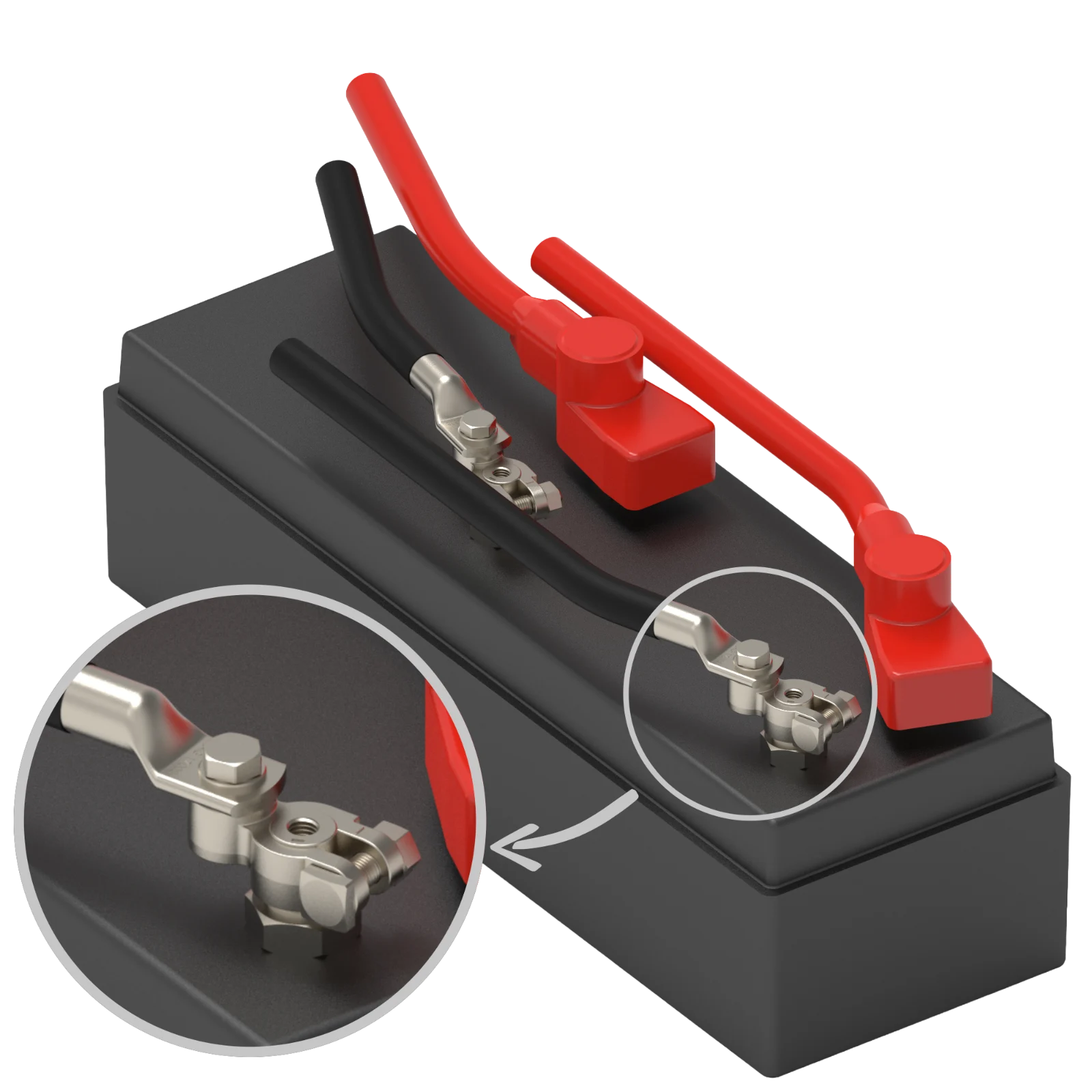
Cone adapter in the existing internal thread with an additional battery clamp
Cone adapter, battery clamp, cable lug
Custom solution
Initial situation
When an inverter is electrically connected, cable lugs are fastened to existing internal threads by screw connections. Despite defined torque specifications, users in practice sometimes tighten the fastening screws with excessive torque.
The resulting mechanical loads can damage the underlying busbar or its connection. In the worst case, the electrical connection can break off. Damaged or inadequate contact points can increase contact resistance, which can lead to severe heating and even a risk of fire.
Solution approach
To avoid this problem, a specially designed cone adapter is screwed into the existing internal thread of the inverter. The cable lug is then electrically connected via an additional battery clamp that is mounted on the cone adapter.
The key advantage of this design is that the clamping forces are decoupled from the original screw connection. The required contact force is transferred to the cone adapter via the horizontally arranged clamping screw of the battery clamp.
As a result, the tightening forces generated when fastening the cable lug are no longer transmitted directly into the internal thread and the underlying busbar connection. This significantly reduces the risk of mechanical overload and damage to the original terminal connection.

Cable lug screwed on directly
Cable lug on a battery clamp mounted on the cone adapter
Customer benefits
Increased operational safety: Reduced risk of mechanical damage and resulting thermal problems.
Protection of existing components: Less mechanical stress on the internal threads and the underlying busbar connection.
Reliable installation: The cable lug is fastened independently of the inverter’s original screw terminal.
Easy integration: The existing terminal geometry is used by fitting a matching cone adapter and an additional battery clamp.
Similar application?
We develop custom solutions for the mechanical decoupling of terminal screw connections. Talk to us about your application.